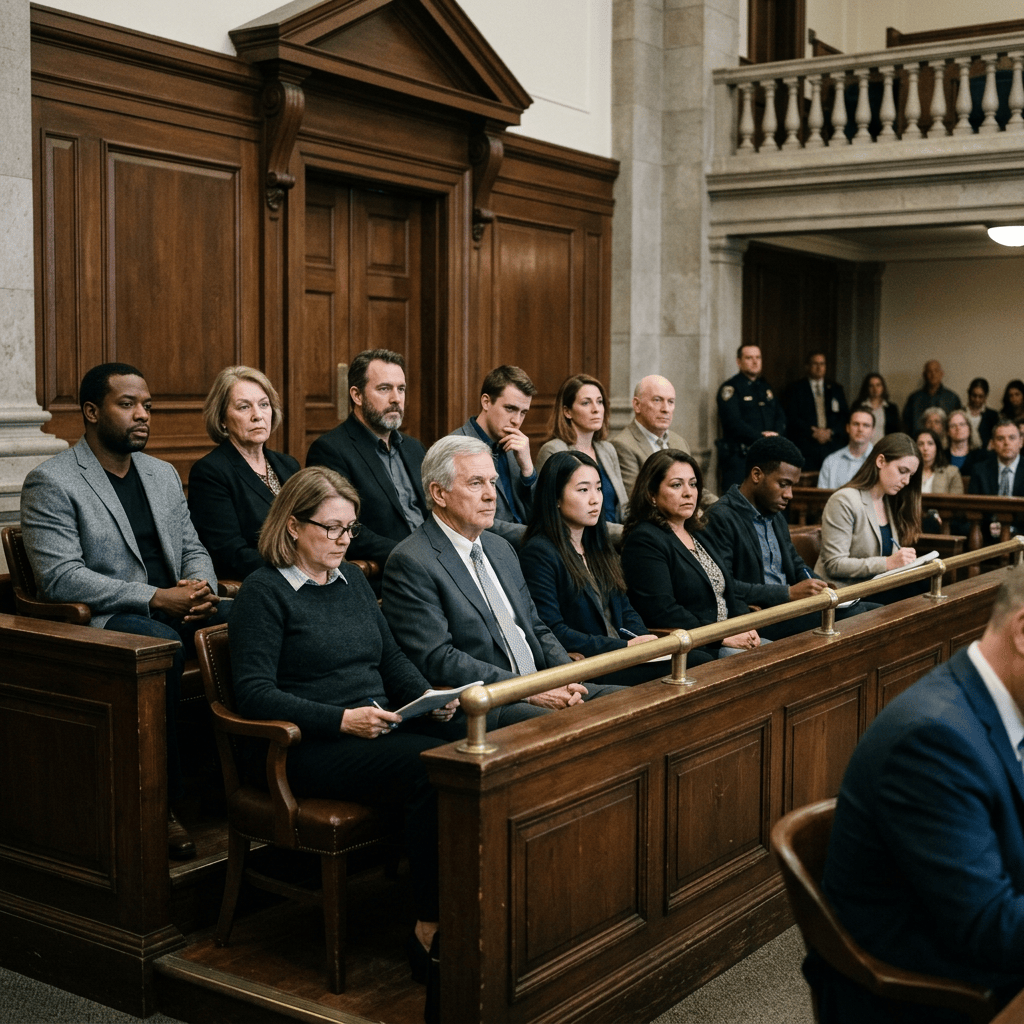
Community members listen attentively from the gallery during a formal courtroom proceeding.
If the late Ken Dodd was to be tried again today on the same evidence for alleged tax evasion, I am convinced that a modern jury would not have hesitated to convict him. Because today’s jury is more savvy. Less likely to be bamboozled by someone’s celebrity. We saw that in the conviction of cuddly children’s entertainer Rolf Harris a few years back. And he was not alone. It’s why I am always impressed by the collective wisdom of today’s juries: the men and women which the Starmer government wanted to abolish for mid-range offences. I’m so glad that Burnham has seen sense.
Because the real damage from a criminal conviction is not the slap on the wrist from a judge or magistrate. It is the long-term reputational damage. The ruination of a future career. So wouldn’t you want your case to be tried by men and women who could see life through your eyes? Instead of a state appointee?
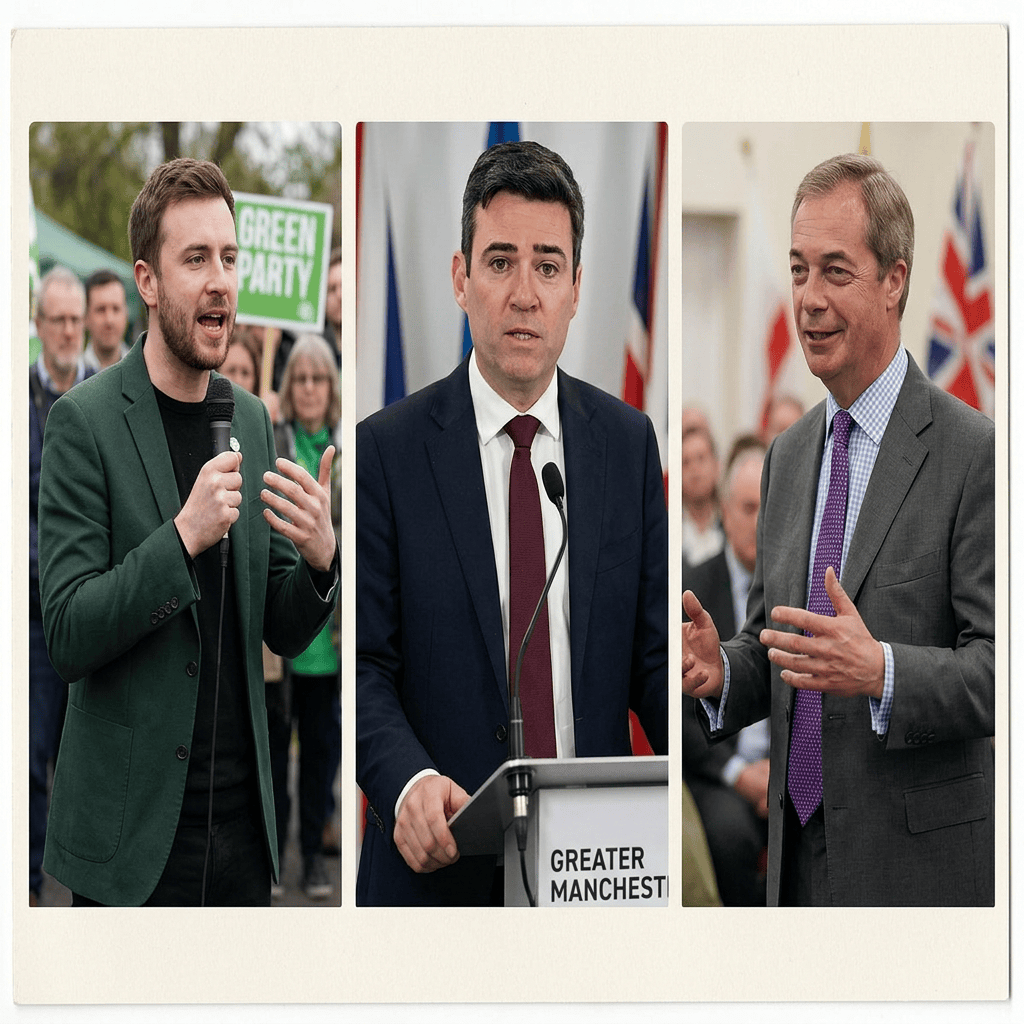
A three-panel collage presents prominent British politicians speaking at public events.
With so much rubbish on the freeview channels, I have taken to watching the recent party conferences. I’d much rather be entertained by a great speaker than bore myself watching celebrity game shows. And aren’t there too many of those? Where gameshows and Eastenders’ become the ‘news’. Even though it’s all pretend. Talk about dumbing down! I’ve shown Farage; Polanski and Burnham in the picture because they are the political leaders I most enjoy watching. I don’t have to agree with them to like hearing them speak.
When it comes to presentation, party politics, for me, has never been better. A move away from the complacency of the past. New ideas. New faces. Though for me, some of Andy Burnham’s shine is beginning to wear off. It’s one thing to talk about growth in the economy. But he doesn’t seem to be doing anything to make it happen. Instead there is hesitancy even over the Heathrow Airport expansion, not to mention the Jackdaw and Rosebank oil and gasfields. all of which are supported by the main unions, including the TUC, because of the jobs they will create. When I attended a recent Back Heathrow Airport Event at Hounslow’s Gymkhana Club. I was impressed by the turnout from the Unite and GMB unions. Andy – please listen to them – instead of wittering about Britain rejoining the EU. Kemi Badenoch is for me still the unknown quantity and I look forward to seeing her speak at the forthcoming Conservative party conference. But her promise has for me being marred by her recent support for Joshua Bonehill-Paine becoming a Conservative councillor. Why? What was that all about? Bonehill-Paine might be a reformed character but none of us can erase our past. The damage has been done. But I’ll listen to what Kemi has to say. I hope that she can come up with some real ideas. Gimmicks like abolishing inheritance tax just don’t cut it for me. And wasn’t her predecessor, David Cameron, all about gimmicks? Like ‘localism’. And as leader of the opposition, she has to do more than just ‘oppose’. And as for Ed Davey? Well? What can I say? Falling out of boats is never going to win my vote. I need to know what he stands for. So what is it that makes the three-party leaders shown in the picture so engaging? And what can we learn from them? Here are some suggestions:
Be genuinely passionate about your subject. If you are passionate, you don’t have to worry about what you are going to say. The words will just come. A passionate speaker sells emotion.
Have you noticed that none of these speakers ever use notes.? Burnham doesn’t even stand behing a rostrum. Glancing at notes means that you break eye contact with your audience. And it is the eye contact which creates the power in a good speech.
Structure your speech. Not just a beginning, middle and an end. Remember the salesmans’ acronym AIDA. Say something to get the audience attention. Summarize the theme. Back it up with facts and argument. And finally the call to action.
Don’t ramble. You are not a lay preacher. Know what you want to say. Say it. Summarise it. Sit down. Learn to read your audience. When you see them fidgeting. Whispering to each other. Looking up their phones. Have the courtesy to shut up. Don’t wait for people to start walking out.
Be heard. You don’t need to tap a microphone if you can throw your voice to the end of the room.
Actively look for opportunities to speak. Maybe through your work or special interests. Or join a speakers club.
Buy a copy of Dale Carnegie’s ‘The quick and easy guide to Effective Speaking’ [my call to action]
I’m nervous about Leveson’s proposals to abolish jury trial in intermediate cases and replace them with trial by a judge and two magistrates. It is as though he’s suggesting that either way offences carrying a likely penalty of less than 3 years imprisonment are not serious. But a theft conviction can be very serious if you lose your career as a result. Fair enough if you are actually guilty of the offence charged. That’s where the jury comes in. People like you and me with the same collective sense of fairness and justice. Not quite the same when you are facing an impatient prosecution-minded magistrate or judge who just wants to get through their case list. And what is the point of even electing trial, if you are not going to get to argue your case before 12 people who are living similar lives as you are.
Another thing I have long noticed is the increasing remoteness for our justice system from common expectations of right and wrong. Where everything seems to be decided on on academic technicality. We’ve come a long way since the passing of ‘people’s judge’, Tom Denning. Then there is the secrecy over the judicial appointments process itself. Whether it’s the appointment of judges and magistrates or the members of a parole board, who ignore public outrage when releasing a dangerous murderer. Who appoints these people? I’m sure that I have never been consulted. All that is left between them and us is 12 members of a jury. Now they want to take that away, Why? Because of successive government incompetence when it comes to our criminal justice system. How does it save money by delaying a case for two or three years instead of bringing it on now? It just doesn’t make sense to me.
My own solution would be to move to an American system of elected judges and magistrates. Make them accountable.
My heart always sinks when I see news footage of hobby eco-protesters standing outside a court building, waving placards, and celebrating the stalling of yet another commercial project. This time It was the Rosebank oil exploration project, off Shetland, in which Shell had invested £800 million and involved one of the largest undeveloped oil and gas fields in the UK continental shelf, containing an estimated 300 million barrels. And why do our most senior judiciary seem to think it is their mission to wave their green credentials to tease out the tiniest administrative flaw in the regulatory approval process, to send everything back to the drawing board? Who appoints these people? It follows hot on the heels of another court judgment crushing implementation of proposals to open Britain’s first new coal mine at Whitehaven, for more than 30 years. In each case, the judicial mantra was the same. “That the proposals failed to adequately assess the greenhouse gas emissions tied to burning fossil fuels.” And we know that with a government energy minister so opposed to fossil fuel extraction, that none of these projects are ever likely to happen. But haven’t these eminent legal brains slightly missed the point?
Yes – we know that burning fossil fuels causes climate change. Which is why we need to put in place viable alternatives .But neither the Rosebank nor the Whitehaven projects were about burning fossil fuels. They were about extracting fossil fuels so that we don’t have to import them from abroad. Either way. fossil fuels will still be burnt, because at the moment we have nothing else. And of course those projects would have also created thousands of well-paid jobs. So what is the point they are making? And it is entirely appropriate for me to refer to these eco-protesters as hobbyists, as none of them would have suffered direct personal detriment as a result of either of these projects. It is all about the big abstract ‘we’. And what message does it send to the outside world? A Britain which is so up itself that it is prepared to cut off its nose to spite its commercial face. Who would want to invest in us? The next big battle is going to be about the proposed third runway at Heathrow Airport. Even if it goes ahead, I’m not sure that I will still be around when it is completed. But that’s no reason not to support it.
I really blame the last conservative government for this farce. They had 14 years to drive these projects through. But instead they preferred to spend their time posturing about Brexit and their precious Rwanda scheme, as everything else around them fell apart. And they were a government which was in hock to the NIMBY lobby, which is why the cost of HS2 ballooned almost to the point of cancellation.
When it comes to the third Heathrow runway, I’m with Rachel Reeves. I know she’s had a bad press, but I’m convinced that she’s trying to do her best to grow the British economy. Again, so different from the last lot, the ‘party of business’. But even now, opposition to the third runway is cranking into gear, not least from London Mayor Sadiq Khan, who has promised court proceedings to try to stall the project.
Spending my money to fight a court case against his own parliamentary party? What is that all about? And he hasn’t even consulted me. A case of public money fighting public money. How wasteful. But that is Britain today.
Starmer’s mistake was not that someone else paid for his wife’s clothes but that he did not follow protocol in declaring it. But wouldn’t you think that he would have known that?
Contrary to what many people think, there is no law which says that someone in public office cannot accept hospitality, in circumstances when it might be considered insulting to refuse. But there has to be transparency.
All public sector organisations have a hospitality book in which you can write in hospitality which is offered to you and you are minded to accept. It might be a pair of cuff-links. It might be an invitation to a ‘black-tie’ dinner. Take a few moments to look your organisation’s hospitality book to see what other people have written into it. You may be surprised,