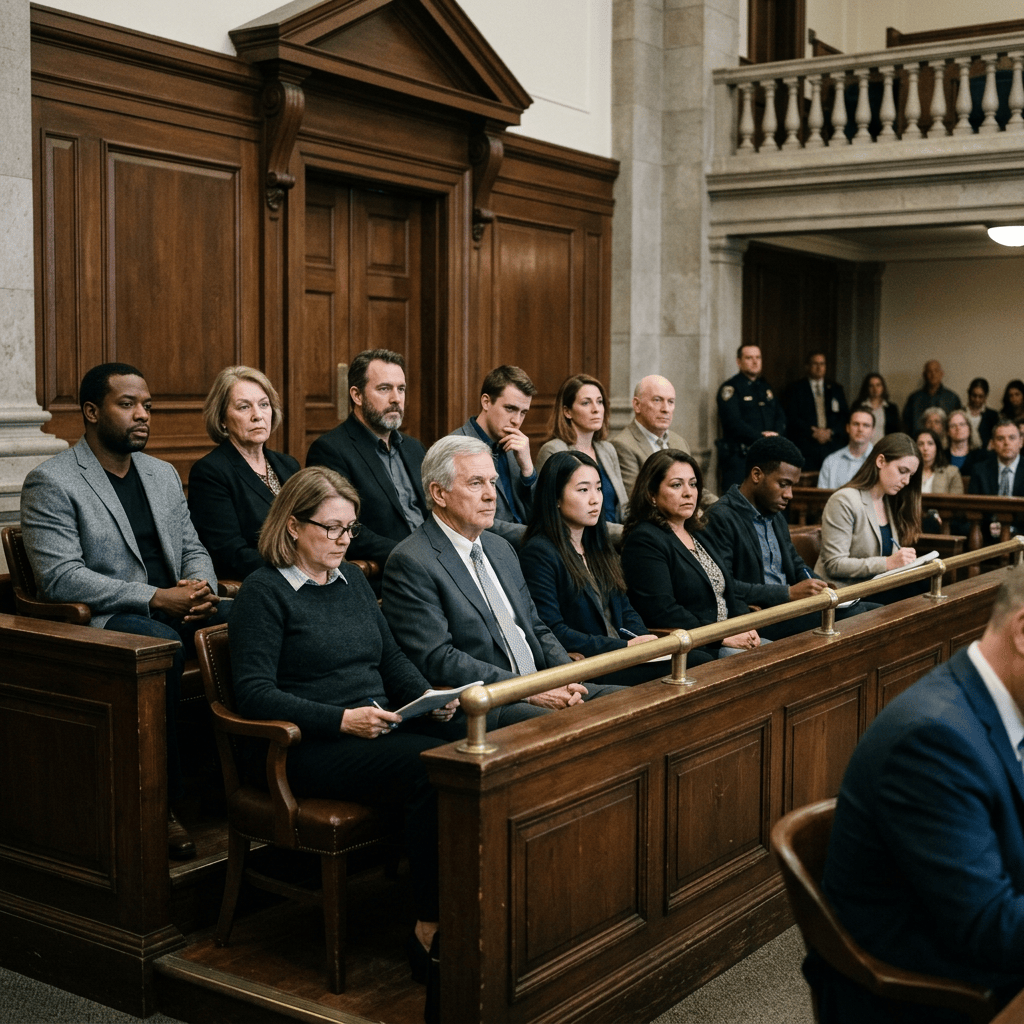
Community members listen attentively from the gallery during a formal courtroom proceeding.
If the late Ken Dodd was to be tried again today on the same evidence for alleged tax evasion, I am convinced that a modern jury would not have hesitated to convict him. Because today’s jury is more savvy. Less likely to be bamboozled by someone’s celebrity. We saw that in the conviction of cuddly children’s entertainer Rolf Harris a few years back. And he was not alone. It’s why I am always impressed by the collective wisdom of today’s juries: the men and women which the Starmer government wanted to abolish for mid-range offences. I’m so glad that Burnham has seen sense.
Because the real damage from a criminal conviction is not the slap on the wrist from a judge or magistrate. It is the long-term reputational damage. The ruination of a future career. So wouldn’t you want your case to be tried by men and women who could see life through your eyes? Instead of a state appointee?
Using AI is like taking legal advice from a man in a pub. You might come away with some good tips. Though you wouldn’t want to trust his advice without first checking it out. Particularly if you are preparing a case for trial. But so many lawyers seem to do just that. Particularly those still at the learning end. They’re the ones getting caught out. But it is usually their employer who gets the grief.
Think of AI as an advanced search engine. It does more than simply searching out internet content and presenting it to you as a series of links. It goes further by mashing up that content and then reconstituting it as its own work. So is it surprising that AI sometimes gets it wrong? And there’s another thing. Everything downloadable from the internet is somebody else’s intellectual property. So when you are reusing that mashed up content and passing it off as your own work, you are opening yourself up to a damages claim.
Don’t get me wrong. I sometimes use AI myself. But only a starting point. I might ask it to list out some cases relevant to the matter with which I am dealing. I will then go on to the BAILII website and search out those cases and download the PDFs. But sometimes my AI has responded with an answer which I know is wrong. So I will always defer to my own professional judgment. Because that’s what I’m paid to do. And yes – I can always sense when something has been written by AI.
Christmas has come. Shorthold tenants are now sitting tenants. You can live there as long as you want to. Just as long as you pay your rent and are neighbourly. Except if your landlord had already served the section 21 notice on you before the end of April 2026. Then it’s just about waiting to see if possession proceedings are issued before the 1st August 2026 cut off. If those possessions proceedings have been issued, it may then take a couple of weeks before you even find out about it. Because a congested civil court system is going to become even more stretched with thousands of landlords issuing their section 21 claims before the statutory cut off. Then there’s the bailiff’s appointment to carry out the actual eviction – which potentially could take much longer. Because bailiffs are going to be very busy.
Being a sitting tenant does not mean that your continued occupation is guaranteed. Because even under the new rules, a landlord can still initiate an eviction process if they can prove a genuine intention to sell the property with vacant possession. But that’s going to be a long-winded process.
For those landlords who are staying in the market, get a reputable letting agent. Someone who is up to speed with the changes. Even if you have to pay a little bit more for that quality of service They will be the people on whom you will be relying to protect your interests. Between now and the end of May 2026, there is work which they need to attend to, to protect you from big financial penalties.
It’s also going to be a busy time for your local council. Especially their homeless team. Everyone who has received a section 21 eviction notice before the 30th April 2026 cut off is going to need somewhere else to live. But only those former tenants with a ‘priority need’ (for example those with children or a serious health condition) can be guaranteed somewhere to live, even if it’s only bed and breakfast. So there’s going to be lots of business for hoteliers.
if you want to receive further alerts about the implementation of the Renters’ Rights Act please use the MailChimp link to sign up.
Processing…
Success! You're on the list.
Whoops! There was an error and we couldn't process your subscription. Please reload the page and try again.
I’m always astonished that any industry still exists in the UK, with the highest energy costs in the world and successive governments which, for as long as I can remember, have been too quick to procure goods and services from abroad, even when it means the loss of UK jobs. Whatever happened to a level playing field? It’s also why I’m encouraged by the Local Government (Exclusion of Non-Commercial Considerations) (England) Order 2026, which allows local authorities to favour either UK companies or those which are locally based, when making procurement decisions. But the new legislation has its limitations:
The ability to favour local industry or that which is UK based only applies to the lowest tier of procurement which does not have to go out to formal tender. This means supplies or services contracts with a value under £207,720 and works contracts which are under £5,193,000
The legislation is permissive. which means that councils are under no obligation to favour local business or that which is UK based. Any council which wishes to use the legislation must update its contract standing orders to allow it to do so and also make clear in any advertisement that bidding is limited to UK companies or those which are locally based
I’ve just managed to renew my solicitor’s practising certificate for 2025/2926. For a non-techno like me, it was so much more difficult just to log on to the SRA website to make the application. In previous years I would just put in my log in details and password and then receive a one-time password, which I would then type in. Bingo! I’d only need another 10 minutes to complete the online application, make the payment, and my practising certificate would be on its way. Not this year.
Faced with the dreaded QR code, I spent many hours trying to suss out my cell phone to generate the six digits which would get me into the website. Up to then, my phone’s primary use had been – well – phoning! And perhaps the occasional text message. Whatsapp? Forget it! I watched the ‘ how to log on’ video on the SRA website. Then struggled again.
It’s pure luck that at the end of my road there is a small computer shop where I was able to get help to navigate through the technical barriers and complete my application. Well worth the £20 I paid the guy for his trouble. But it means that I won’t have to worry about that for another year.