I got my dose of 2025 flu a couple of weeks back. It took me by surprise. Only a month previously I had got my annual flu injection.
Don’t get me wrong. Today’s flu injections a lot more effective than they once were. They actually stop flu instead of causing it. In fact I’d already gone several years without a severe cold or flu.
As a registered asthmatic, I can sense immediately when an infection is about to go down onto my chest. So I don’t wait until it gets worse before booking my doctor’s appointment. I got that appointment within an hour of making my telephone call. In fact there was scarcely a wheeze as the medic checked me over with her stethoscope; checked my blood pressure and gave me a peak flow test. Next morning, I picked up my penicillin from the pharmacy at the end of my road, by which time the congestion was already beginning to kick in and I took the first capsule immediately. 5 days Later I had finished the course but there was still some residual congestion waking me up at night.
Against media advice, I didn’t spend 2 weeks lying in bed. What would have been the point of that? I got up and switched on my computer and did a couple of hours work before the weariness caught up with me. I suppose I’m lucky in being able to work from home in this way.
When every time you make eye-contact with someone, they offer you their seat.
When you celebrate every birthday with another tablet.
When you eat less but put on weight. Like the 70’s rock band who decided to reform, looking like they’d just walked off a building site.
Things to Do When you are getting old.
Make a will. It goes without saying.
Make that extra effort to keep in touch with friends and family – especially the younger generation.
Make a Living Will or Advance Direction, so you are in control of your own destiny, when it’s time to say goodbye.
Things not to do.
If you love your job and are at the top of your game, whatever you do, don’t retire, even if you’ve reached state pension age. Yes – take your company pension. You’ve worked for it and paid in to it. But don’t let it stop you working. And you don’t have to. Go freelance if you need to. You may also discover that your earning potential has never been higher. Because you will be getting your pension – PLUS – what you get working. And if you are past state retirement age, you won’t be paying any NI. What a great tax-break that is! So let someone else walk up and down a golf-course or kill time on a bowling green.
What point was Hancock actually trying to make at the Covid-19 inquiry, when he talks about ‘doctrinal failures’ with an emphasis on cleaning up after a pandemic instead of preventing it from happening? Is he saying that Britain should have locked down even harder and faster? So why didn’t he just say so? Why wasn’t he challenged on what he was really trying to say? More importantly, why wasn’t he challenged about leaked messages suggesting he favoured “scaring the pants off everyone”? Well it didn’t scare the pants off me.
For me, Hancock’s evidence was just too hand-wringing; too vague; and too short on specifics. It just didn’t get to the point. Who cares about his personal feelings? We want facts. And it all went unchallenged. It was all too ‘polite’ for my liking. Too cosy.
My worry is that is that the key questions regarding the justification for repeated lockdowns; mask-wearing; and standing in line outside supermarkets will not even be addressed at this public inquiry. Instead, it will assume that every one of these measures was necessary because that was the policy which the government had decided to follow. Even though the government was being led by the nose and was frightened of being seen as out of step with other jurisdictions, even with Nicola Sturgeon. And there was no opposition. Any alternative view was quickly shut down. We also know that the inquiry won’t even have the most crucial evidence to determine how these decisions were made.
Yes-Boris Johnson has surrendered his WhatsApp messages to the inquiry. But these only go back to April 2021. What is the point of that? Instead, we had the excuse that his earlier phone had been compromised. But those earlier messages must still exist somewhere in the ether? And what’s all this about the government bringing legal proceedings against its own inquiry to stop information going into the public domain? We want to know what messages were exchanged between ministers and top civil servants at the beginning, in March 2020, when government policy suddenly changed from herd immunity to lockdown. If it was all just to “scare the pants off us”, we need to know.
The real message I take from Partygate was that those at the top of government who were attending those lockdown parties knew that they weren’t putting their health at risk. Otherwise, they wouldn’t be doing it. So why the pretence? Why impose restrictions on everyone else?
Yes-we all know someone who has died of covid. Just as we all know people who have died of heart attacks. Of cancer. Of suicide. But I’m sure that no account will be taken of that at the public inquiry. Nor of young people who studied for years for examinations which they were never allowed to sit. A teacher-assessment is never a substitute for a robust external examination. It’s too subjective. And will anyone challenge the nonsense of closing down someone’s livelihood whilst at the same time printing money out of a bankrupt economy to pay them to stay at home? And then there’s the fraud. The cronyism. If we can’t afford to pay nurses, how could we have afforded to pay for that? And why did covid quickly become the excuse for any poor customer service? “It’s covid innit.”
Perhaps I’m wrong. Maybe later in the inquiry we will get some serious questioning of the knee-jerk policies which caused so much damage to so many people as they swung backwards and forwards? Maybe. But I’m not going to put money on it.
When life changes, it does so suddenly. There is no lead-in. One day life is powering along. You get up, go to work, come home, have something to eat, watch the telly, and perhaps go out together to a restaurant or plan your next holiday. And then. Bang! Something happens to disrupt that daily routine. Whoopee! You’ve won the lottery. For most of us, life isn’t like that. More likely, it is something you don’t want, like an accident in the family. It happened to us a week before Christmas, when Farida, my partner, tumbled in the hallway as she was trying to get to the front door. It was a soft fall in which she landed on carpet but was the latest in a series of falls both in and outside the house, which had meant that she was already unsteady on her feet. But this time, she couldn’t get up and has since been unable to walk. Farida is currently awaiting an operation at the Chelsea and Westminster Hospital, which we will hope will put matters right. But in the meantime, I have become a full-time carer. Because there is no one else to do it. Just the two of us. So it’s about learning quickly how to cope with this new situation and deal with issues relating to personal care and transport. How do you get to and from hospital appointments, if you can’t get into a car? How can I even go to the shops, unless there is someone, whom we can trust, to provide care whilst I am out of the house? I have also had to cancel my own dental appointments because there was no one to cover whilst I am away. Let’s start with transport.
Getting about now means finding a motor vehicle capable of accommodating someone sitting in a wheelchair. Fortunately, there are specialist wheelchair taxis and minicabs. These are sophisticated pieces of equipment, with either a ramp or an electric lift to get Farida and her wheelchair inside the vehicle. At around £24 one-way for the short journey between our home and West Middlesex Hospital, wheelchair transport is surprisingly affordable. The problem is one of availability, as there are so few wheelchair cabs around, so it is first come, first served. They are particularly busy during the school run. It is easy enough to book in advance for a wheelchair cab to take you to the hospital. But what do you do, when you want to come home? You can’t pre-book because you don’t know when the hospital appointment and any associated tests, will finish. On one occasion we were kept waiting 3 hours because there was nothing available to take us home from West Middlesex Hospital.
The next issue is finding some paid help in the house to free up some of my time and help me cope. If I can’t do my job, I can’t earn any money to pay for the care. Like many of us, I am lucky that I am now able to work from home. So thank you Microsoft Teams. No more traipsing up to London for meetings. So how do you go about finding paid help?
It would seem to me that there are three ways of finding paid help: through the local authority; through a private agency; or by finding someone yourself. I prefer the last. It is about finding a female carer with whom we are both comfortable in placing our trust. That person will also have to come with us to hospital appointments to help with personal care. It is about trusting our own personal judgment and feelings about a particular person. It means that the money I pay goes straight to the carer instead of to an agency. It means that we get the person we choose and not someone who is sent to us by someone else. It also offers flexibility, because we can call the person whenever we need them. Just hoping that life changes for the better once Farida has had her operation. Just a final word.
Although the NHS has recently had a very bad press, I have never complained about the care and support we have received from medical staff over the years. They have always been there to look after me.







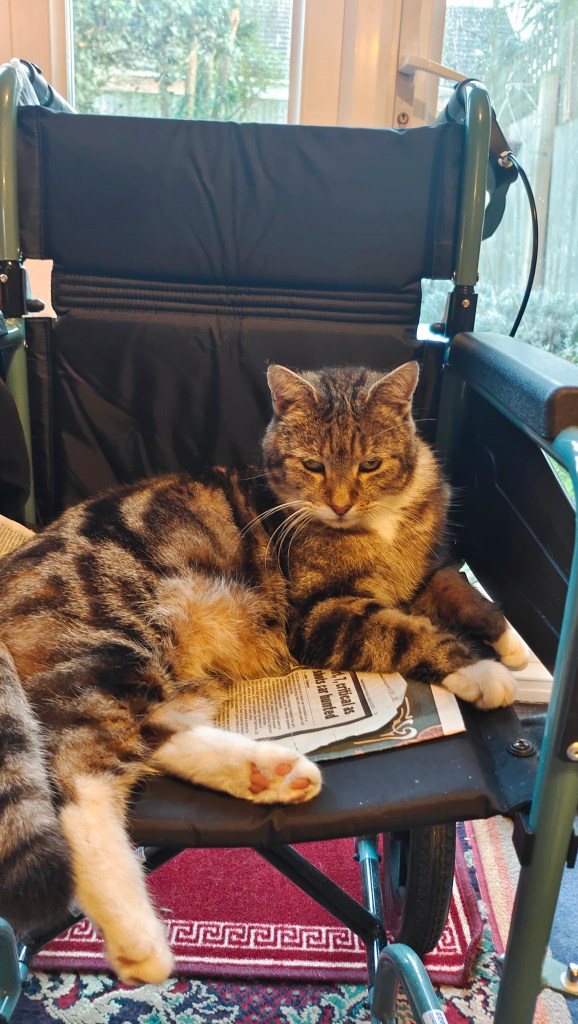


 BRUCE AND HOLLY